Collectible Design — 2026

Nisuz Prints
modular collectible figures

An idea that exists only in the mind, pushed all the way through to something you can hold. Nisuz Prints is a personal concept turning digital sculpts into hand-finished, modular action figures — sketch to screen to physical object.

Role
3D Design, Print & Finish
Year
2026
Material
PLA
Status
Ongoing series
3D Sculpting, Product Design, Branding, 3D Printing, Collectibles
01 — Concept

Nisuz Prints is a concept built on one simple idea: turning what exists only in the mind into something you can hold in your hands.

It started as a personal experiment — using digital tools to design objects that don't exist yet, and 3D printing to give them a physical form. Instead of stopping at a sketch or a digital render, every idea is pushed all the way through to a finished, tangible product.

The first project to come out of this process is a series of modular, collectible action figures. But Nisuz Prints isn't only about the figures themselves — it's about the full journey behind them: an idea, shaped into a 3D model, prepared for printing, and finally produced and finished by hand. That journey — from concept to object — is the core of the brand.

02 — Product / Process

Print-Ready Graphics

Alongside the physical figure, Nisuz Prints also designs and prints its own stickers and packaging graphics. These are prepared as production-ready files: a 2–3 mm bleed around every die-cut shape, a separate cut-line layer for the cutting plotter, and full CMYK conversion to match the printer's color output — the same attention to technical detail as the 3D side of the process.
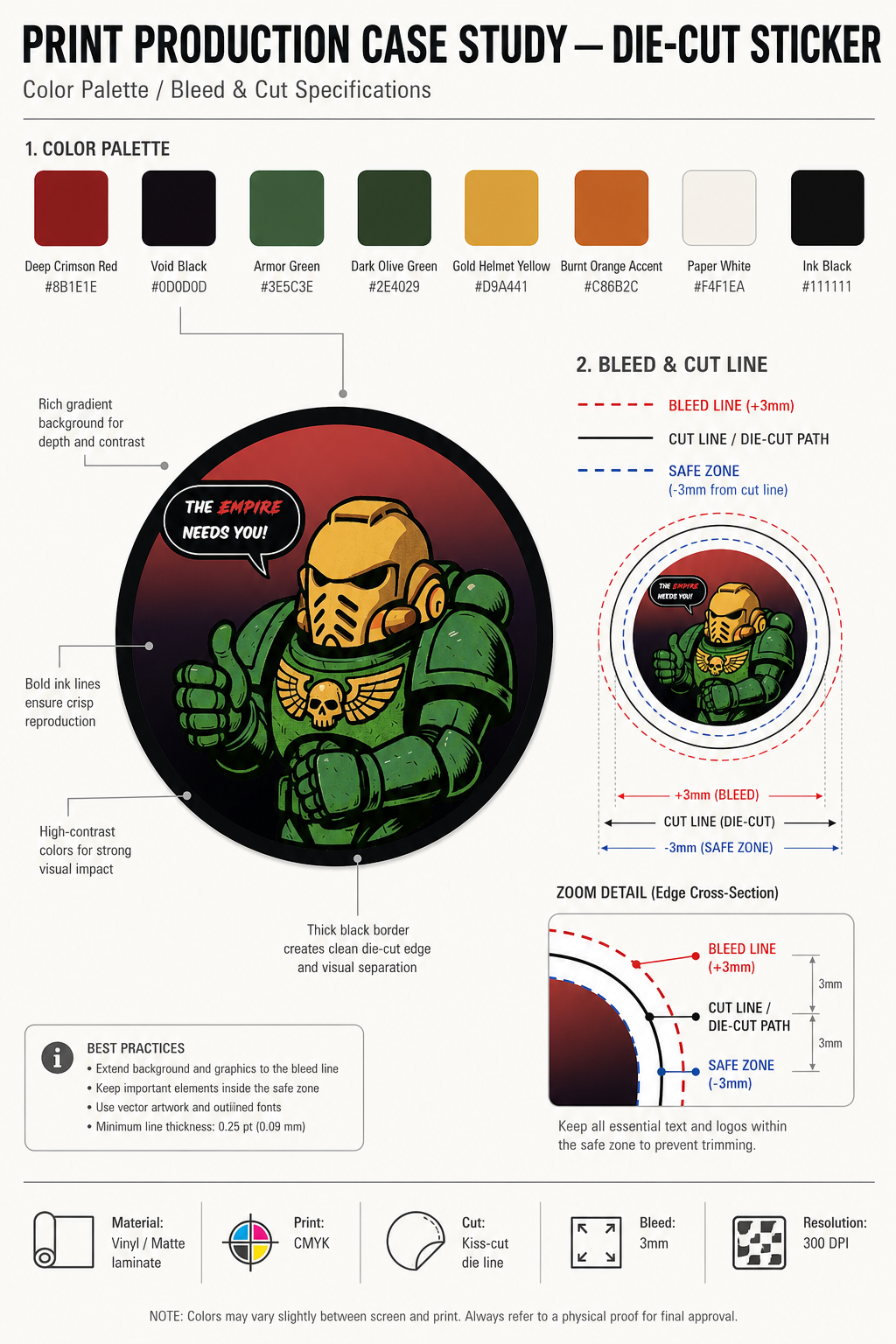
Nisuz Prints — die-cut sticker artwork with bleed and cut-line layers
Die-cut sticker artwork — bleed & cut-line layers

3D Modeling

Every figure begins as a digital sculpt in Nomad Sculpt, ZBrush, and Blender. The process follows a clear structure:

  1. 01Blockout — establishing the base shape and proportions
  2. 02Detailing — sculpting armor plating, emblems, and weapon geometry
  3. 03Splitting into parts — separating the model into individual meshes that match the final physical parts: torso, arms, legs, helmets, shoulder pads, and weapons
  4. 04Scale calibration — sizing the model to match the final physical dimensions (12 cm)
  5. 05Export — preparing clean STL files for slicing

Each joint is designed as a peg-and-socket connection, allowing the figure to be assembled without glue and re-configured afterward — helmets, weapons, and armor pieces can be swapped freely.

3D Printing

Once modeled and sliced, every figure is printed on Bambu Lab A1 and A1 mini printers. Parts are printed in PLA and PETG, with layer heights adjusted between fine detail areas (like helmets and faces) and larger structural parts, to balance detail and print time.

After printing, each part is cleaned of support material, sanded, primed, and hand-painted in layers — base coat, shading, highlights, and final details — before a protective finish is applied.

Branding

The name Nisuz is an anagram of the designer's own surname, Zusin — the brand name is, quite literally, a signature. It's paired with the Ω (Omega) symbol. The Omega symbol marks this collectible series, representing the ultimate evolution of the Galaxy Commando project inspired by the legendary Ultramarines.

The logotype is built on DELCOM (dafont.com/delcom.font), a geometric, single-weight typeface chosen for its clean, technical look — the same visual language carries through packaging, stickers, and product graphics, so every touchpoint feels part of the same system.

03 — Result

The result is a fully assembled, hand-finished collectible figure — but also proof of a complete production pipeline, from a digital idea to a physical object.

Every finished piece carries its own visual story: a 3D model that started as a rough shape, a sticker and packaging design built around it, and a printed, painted figure that can be held, posed, and customized. The same modular base can be reconfigured into different collectible variants — proof that one well-designed system can produce many unique results.

Nisuz Prints documents that entire path openly, treating the process itself — not just the final product — as part of the design.

Selected views 01 / --